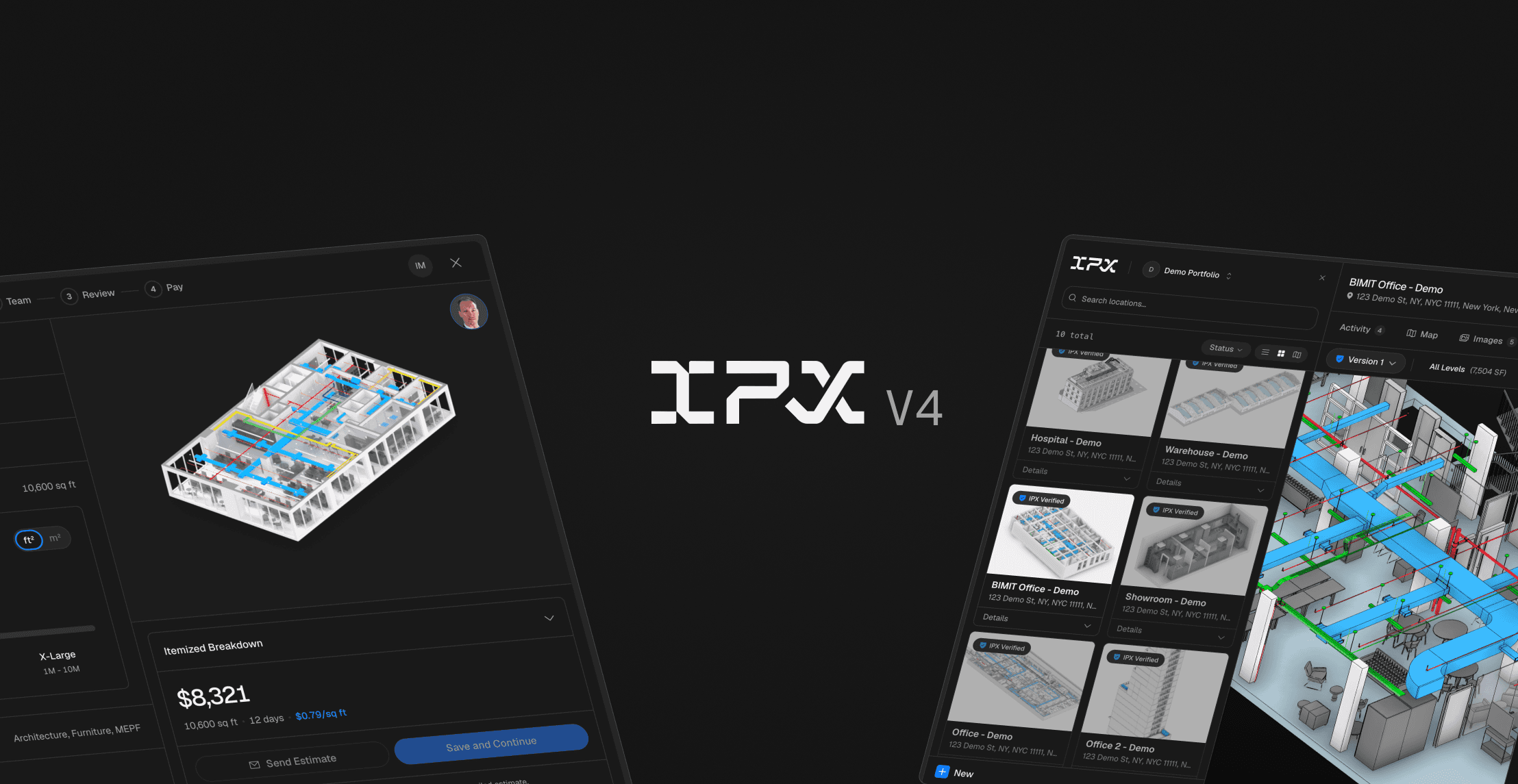
IPX was founded offer a reliable, repeatable solution for turning any building into an accurate digital model. Our first commercial product standardized ordering, scoping, and estimates to create a transparent scan-to-BIM process. We quickly found our market. Just as quickly, we broke our own production process.
"We were growing super fast,” says Deborah Dieguez, head of BIM Operations. “Demand was increasing, and our operational structure wasn't ready for that level of scale."
In March of 2024, we delivered 3% of projects on time.
We needed to fix it or risk failing as a company. And we quickly learned that our problem wasn’t a lack of talent or technology. It was the same one that plagued the industry for decades: A lack of standards.
So we decided to build them.
The foundation
"Two different teams could model the same wall in completely different ways,” Dieguez says. “And both believed they were correct. That’s because we had defined the product, meaning the what, but we hadn't fully defined the how."
To solve problems like this, Dieguez started hosting weekly work sessions that break down every possible element in a BIM, one at a time. Not just to describe what they are, but how they behave in a model, and how they connect and relate to other elements.
"Instead of having guidelines, we started having rules,” she says. “Instead of having descriptions, we started building a system. In a global remote environment, you can't assume alignment. You have to design that alignment."
Building standards like this may be unsexy, but it works. Our production teams grew, we scaled to six buildings a day, and our on-time delivery numbers improved. By August of 2024 — only six months after our all-time low — we hit 80% on-time delivery, and kept improving from there.
Thanks to our new standards, we’ve averaged over 95% on-time delivery for the past 12 months.
Standards unlock automation
Dieguez’s work also laid the foundation for our next big leap. Thomas Czerniawski, a construction site veteran who became a machine-learning academic, saw the value of her work almost immediately.
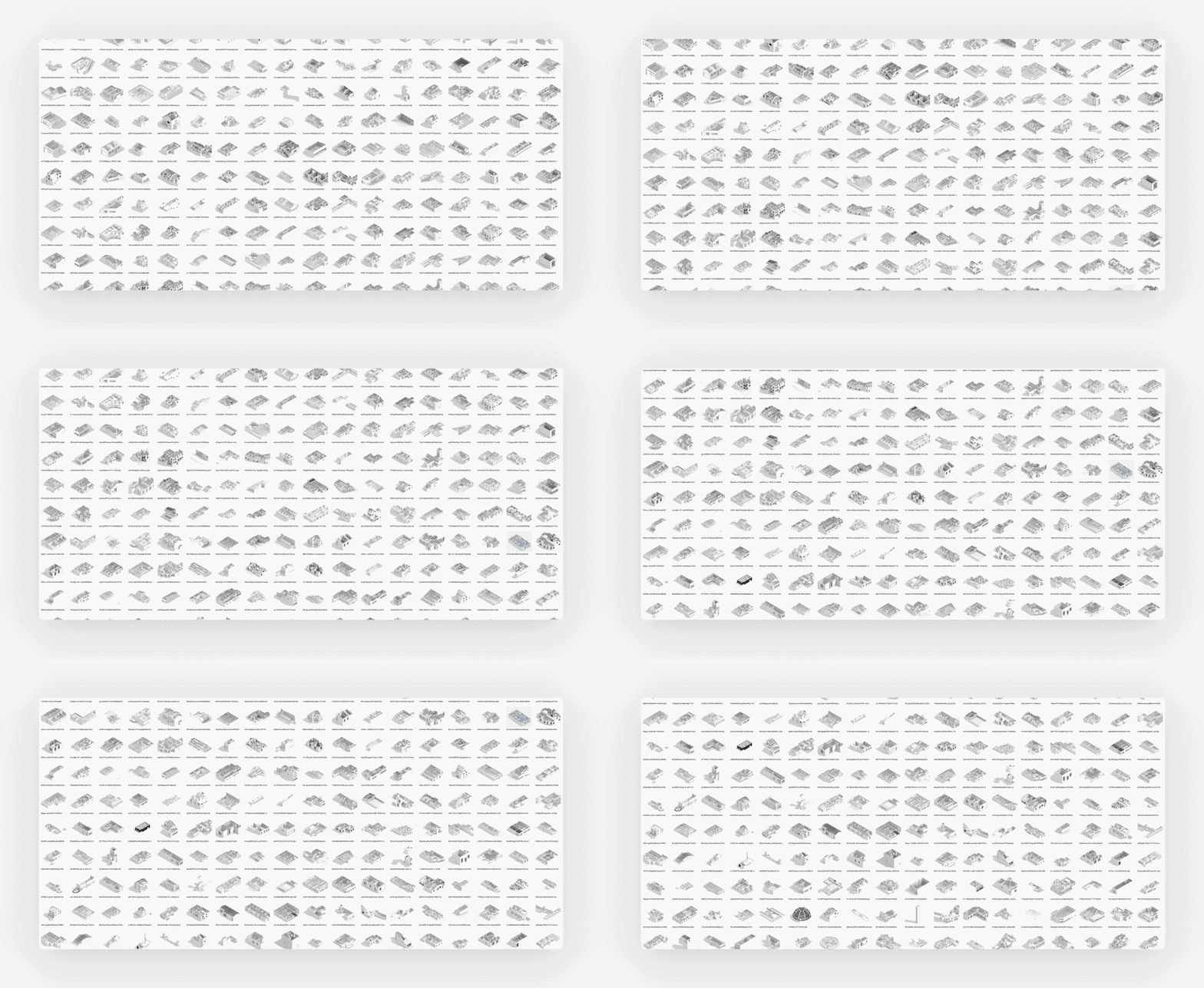
He had been exploring the possibilities of automating scan to BIM for years. But it was impossible to find (or create) enough structured training data for an automated scan-to-BIM pipeline that actually worked.
"You can have an enormous data set,” he says. “But without standards, it's almost impossible to exploit for machine learning. So when I saw IPX’s BIMIT calculator and noticed the rigor of the standardization, I knew I had found a really important part of a training data set."
To gain access to this data set, Czerniawski joined IPX. This set the stage for building our automation technology, which we call the BIMIT engine.
Adding domain expertise
But the data set couldn’t help the team determine what to automate, or how. That required speaking to people who had modeled buildings by hand.
Preston Smith, our head of automation, explains the process of productizing the ML tech: "A lot of what we did when we first started was just talk to people. We sat down. We asked what was going on. Why is this a problem? Why is that a problem? We drew diagrams based on things that were actually happening.”
He recalls a colleague with real-world modeling experience stopping an automation conversation mid-sentence to correct course, saying: "Nope, that's not how you would build that.”
"The better skill of our collective team has been problem definition,” Smith says. In other words? “Not problem solving," but figuring out what the problems with the system were in the first place.
Do or die
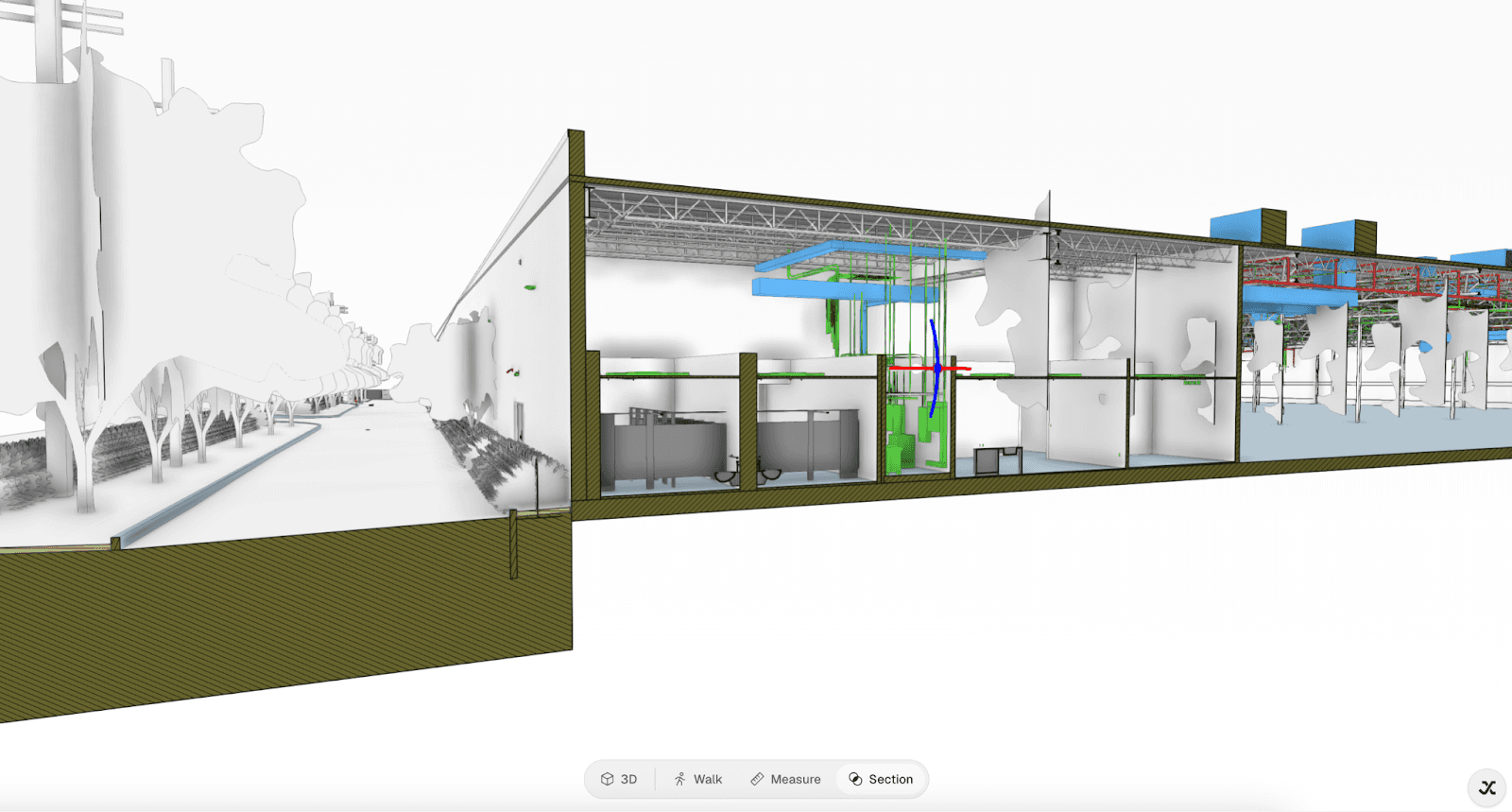
To test the BIMIT engine in a demanding, real-world scan-to-BIM workflow, we put it to work automating our own production. We gave our BIMIT modeling teams access to the engine to speed up the most tedious parts of their jobs.
“The last time that I checked, we were anywhere from 20 to 80 times faster than manual modeling,” says Smith. That has increased our on-time delivery rate to 99%.
And now we’re making it commercially available as BIMIT Plan. The idea is simple: Upload a point cloud, get a schematic floor plan in 2 hours.
Earning your trust
It's early and imperfect, and we want to be clear about that. "Almost all of us who have worked in this space have had some snake oil salesman trying to give us vaporware," says Smith.
That’s why our roadmap includes system benchmark reports for every new release to provide detailed information on what the system did well and what it didn’t. We’re also working on an interface that will overlay the model, the CAD, and the point cloud in a single view for visual inspection.
And we’re adding a tool to the system so you can flag limitations to the team for correction.
"We really don't want to hide anything,” says Czerniawski. “We want to make it as clear as possible where the system can be trusted and where it can't."
"This is the worst it's ever going to be,” says Smith, referring to a system that is 20-80 times faster than manual modeling. “This is the slowest it's ever going to be."